
The Best Japanese Chef Knife in 2026 — Tested & Reviewed
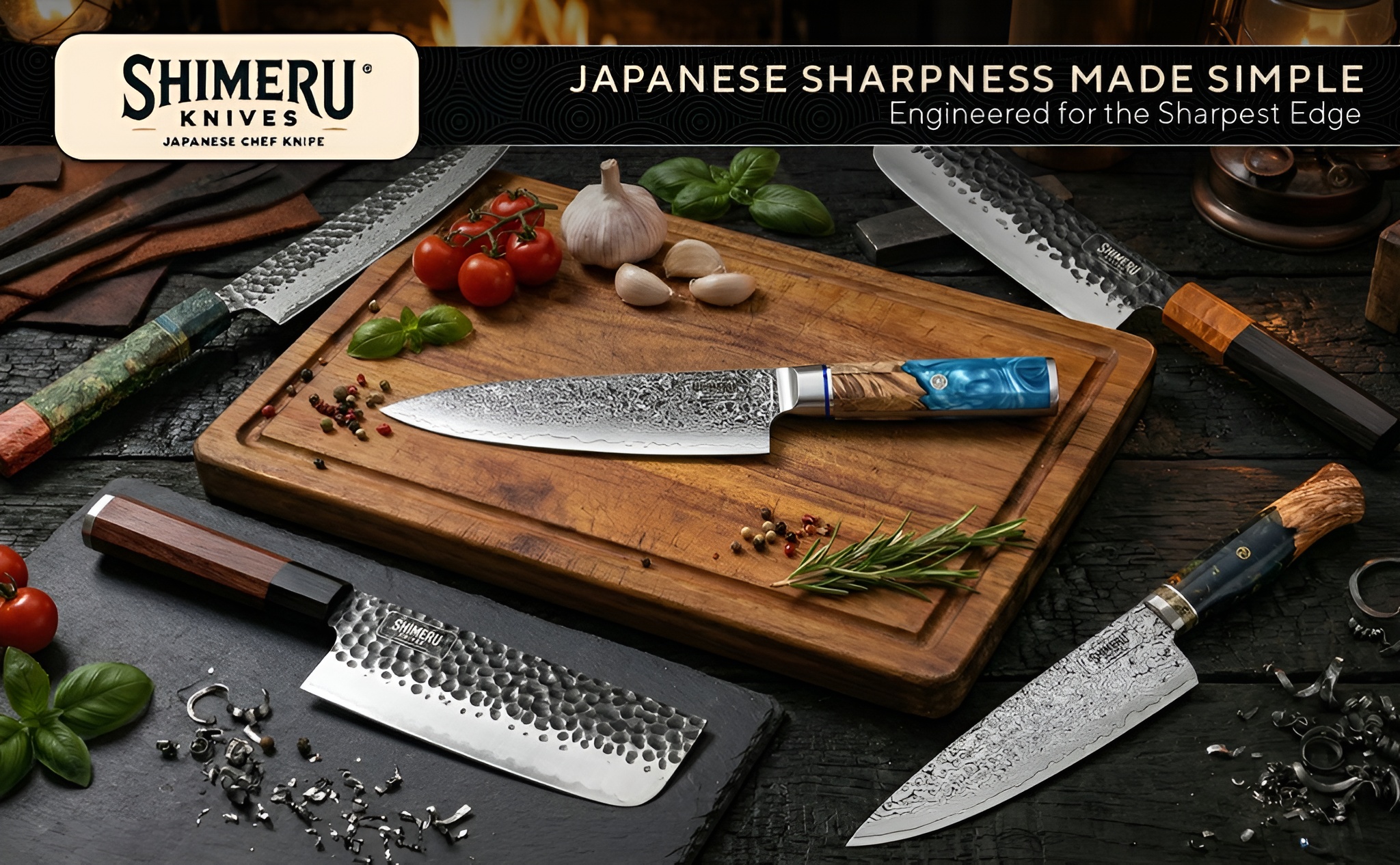
The Japanese chef knife — the Gyuto — is the workhorse of any serious kitchen. Lighter than a German chef's knife, harder at the edge, and ground for clean push-cuts rather than heavy chopping. Buy a good one and you'll probably never reach for another knife for everyday prep.
The problem is that "Japanese chef knife" covers a huge range — from $50 stamped imports to $500 collector pieces. We make and sell Gyutos professionally, and we've put every model in our range through the same daily-prep test (onions, herbs, chicken breast, butternut squash, tomato) to pick the ones that earn the kitchen counter space.
The 7 Best Japanese Chef Knives in 2026 — At a Glance
| Knife | Best for | Length | Price |
|---|---|---|---|
| Otaru 8″ Damascus Gyuto | Best overall | 8″ (200 mm) | $104.99 |
| Misuzu 7.5″ Damascus Gyuto | Best for smaller hands | 7.5″ (190 mm) | $94.99 |
| Kinzan 7.7″ Damascus Gyuto | Best Damascus pattern | 7.7″ (195 mm) | $94.99 |
| Kushiro 8.3″ Damascus Gyuto | Best for big jobs / pros | 8.3″ (210 mm) | $114.99 |
| Natori 8″ Gyuto | Best non-Damascus | 8″ (200 mm) | $89.99 |
| Kakehashi 8″ Gyuto | Best under $100 | 8″ (200 mm) | $74.99 |
| Sendai 8″ Gyuto | Best entry-level | 8″ (200 mm) | $54.99 |
1. Best Overall — Otaru 8″ Damascus Gyuto ($104.99)
If we had to recommend one Japanese chef knife to most home cooks, the Otaru 8″ Damascus Gyuto would be it. The 200 mm blade is the universally-agreed best length for an all-rounder — long enough to break down a whole chicken in one motion, short enough to dice an onion comfortably without feeling unwieldy.
The blade is a VG10 cutting core clad in 67 layers of Damascus steel, hardened to 60+ HRC. That hardness rating is the single most important spec on a Japanese knife — it's why a Gyuto stays sharp through three months of daily prep when a $30 supermarket knife dulls in two weeks. The Damascus pattern is more than decoration too: the laminated construction gives the blade better corrosion resistance and stops the hard cutting core from being brittle.
Pros: Universal 8″ size, hard 60+ HRC edge, balanced in the hand, beautiful Damascus pattern.
Cons: Mid-priced — not the cheapest if you're brand new to Japanese knives.
2. Best for Smaller Hands — Misuzu 7.5″ Damascus Gyuto ($94.99)
The Misuzu 7.5″ is a half-inch shorter and noticeably lighter than a standard 8″ Gyuto. That sounds minor, but for cooks with smaller hands or a compact kitchen, it makes the difference between a knife that feels like a tool and a knife that feels like a chore.
Same VG10 Damascus construction as our 8″ models, same 60+ HRC hardness. We'd also recommend it as the better starter Gyuto for anyone stepping up from a generic Western chef's knife — the slightly shorter length is easier to control while you adjust to the lighter, sharper feel of Japanese steel.
Pros: Easier to control, lighter weight, fits smaller cutting boards, same premium steel as the bigger models.
Cons: Shorter blade means an extra stroke or two on really big jobs.
3. Best Damascus Pattern — Kinzan 7.7″ Damascus Gyuto ($94.99)
If you're going to display your knife on a magnetic strip, the Kinzan is the one to pick. The Damascus pattern on this blade is dramatic — high-contrast wave layers that catch the light differently from every angle.
Beyond the looks, the construction is the same VG10-core 67-layer Damascus build. The 7.7″ length splits the difference between the 7.5″ Misuzu and the 8″ Otaru — a comfortable middle ground for most home cooks.
Pros: Most striking Damascus pattern in our range, comfortable 7.7″ length, premium steel.
Cons: The visual pattern dulls slightly over years of hand-washing (purely cosmetic).
4. Best for Big Jobs — Kushiro 8.3″ Damascus Gyuto ($114.99)
If you regularly cook for a crowd, break down full proteins, or just like a longer blade, the Kushiro 8.3″ is the upgrade. The extra length means fewer strokes per slice, less wrist fatigue on long prep sessions, and enough reach to slice through a full pork loin or a butternut squash in one motion.
Built on the same VG10-clad Damascus platform but with a slightly heavier-feeling balance — the extra 10 mm of blade adds noticeable weight and authority. Feels closer to a traditional German chef's knife in mass, but with a Japanese edge geometry that still cuts cleaner than any Western blade.
Pros: Extra reach for full proteins, less wrist fatigue on long prep, premium build.
Cons: Too long for cramped kitchens or very small cutting boards.
5. Best Non-Damascus — Natori 8″ Gyuto ($89.99)
Damascus isn't for everyone. Some cooks prefer the cleaner, single-tone look of a polished mono-steel blade — and a non-Damascus Gyuto is also slightly easier to clean and sharpen. The Natori 8″ is our pick if that's the style you're after.
It's a single-piece high-carbon stainless steel blade, hardened to the same 60+ HRC as our Damascus models. No layered cladding, no decorative pattern — just a sharp, balanced, mid-priced Japanese chef knife. If you'd rather your tools look workshop-clean than show-piece-pretty, this is the one.
Pros: Clean modern look, easier to maintain than Damascus, $15 cheaper than the Otaru.
Cons: Less visual character; mono-steel can be slightly less corrosion-resistant than clad Damascus over the years.
6. Best Under $100 — Kakehashi 8″ Gyuto ($74.99)
If you want a real Japanese Gyuto for under $100, the Kakehashi 8″ is the pick. Same 8″ all-purpose length as the Otaru, hardened to the same 60+ HRC, but with a simpler handle finish and a single-tone polished blade rather than Damascus cladding.
This is the knife we'd recommend if you're skeptical of premium kitchen knives and want to test whether Japanese steel is worth the upgrade. At $74.99 it's still a serious tool — most $30 supermarket knives use stamped 56-HRC steel that dulls in weeks, while this stays sharp for months.
Pros: Genuine Japanese Gyuto under $100, full 8″ length, 60+ HRC edge.
Cons: Simpler aesthetics; no Damascus layering.
7. Best Entry-Level — Sendai 8″ Gyuto ($54.99)
Our cheapest Gyuto, and a genuine entry point for anyone curious about Japanese knives without committing to a $100+ blade. The Sendai 8″ uses a simpler steel formulation than our Damascus models — closer to 58 HRC than 60+ — but still sharper out of the box than nearly any Western kitchen knife in the same price range.
Honest expectation-setting: this won't have the edge retention of the Otaru or Kushiro, and the finish is plain rather than premium. But as a "is Japanese steel actually different?" experiment, it's the cheapest way to find out.
Pros: Sub-$60 entry into Japanese chef knives, full 8″ length, sharp out of the box.
Cons: Softer steel means more frequent honing; basic finish.
What to Look For in a Japanese Chef Knife
Steel Hardness (HRC)
The single most important spec. Western knives typically sit around 56 HRC; Japanese knives are 58–62. Higher means a sharper, longer-lasting edge — but slightly more brittle, so no twisting on the cutting board and no chopping bones. Anything claiming to be a "Japanese" knife but rated under 58 HRC is using the name without the substance.
Steel Type
VG10 is the most common premium Japanese knife steel — a stainless high-carbon alloy that holds an edge well and resists corrosion. AUS-10 is similar quality at a slightly lower price. Both are fine for home use. Higher-end Japanese knives may use SG2 or ZDP-189 (extremely hard, expensive, harder to sharpen yourself).
Damascus vs Mono-Steel
Damascus cladding (the wavy pattern) is layers of softer steel forge-welded around a hard cutting core. The pattern is decorative, but the laminated build genuinely improves toughness and corrosion resistance. Mono-steel blades are a single piece — cleaner look, easier to sharpen, slightly cheaper. Both perform similarly in the kitchen; the choice is mostly aesthetic.
Blade Length
- 180 mm (7″): Smaller hands, tight prep, controlled work.
- 200 mm (8″): Universal all-rounder. If unsure, get this.
- 210–240 mm (8.3–9.5″): Big jobs, full proteins, long sessions.
Handle
Japanese-style "wa" handles are typically octagonal or D-shaped, made from wood or composite, and are lighter than Western handles. Western-style "yo" handles are riveted bolster-style. Our Gyutos use a Western-style handle for familiarity — most home cooks find them more comfortable straight away.
Japanese vs German Chef Knife — Which Should You Buy?
Both styles are excellent, but they're built for different cutting motions:
- German (Wüsthof, Henckels): Heavier, ~56 HRC, ground for a heavy rocking motion. Forgiving — survives twisting, hard chopping, occasional bones. Needs frequent honing.
- Japanese (Gyuto): Lighter, 60+ HRC, ground for clean push-cuts. Holds an edge much longer but punishes bad technique (no twisting on the board, no bones).
If you tend to crush garlic with the side of the blade, hack through chicken bones, or cook in short bursts where forgiveness matters more than edge precision — stick with German. If you do real prep, want to feel the difference between sharp and dull, and are willing to use the knife the way it's designed to be used — Japanese.
How to Care For a Japanese Chef Knife
- Hand-wash and dry immediately. Never the dishwasher — heat and detergent ruin the edge and the handle.
- No bones, no frozen food, no glass cutting boards. Hard contact chips the edge.
- Hone weekly with a ceramic rod. Realigns the edge between sharpenings; takes 30 seconds.
- Sharpen every 6–12 months on a whetstone. A 1000/3000 grit combo stone covers most home use. Never use a pull-through sharpener — the wrong angle removes too much steel.
- Store on a magnetic strip or in-drawer holder. Block slots dull the edge over time.
Frequently Asked Questions
What's the difference between a Japanese chef knife and a Gyuto?
They're the same thing. "Gyuto" (literally "cow sword") is the Japanese name for what English speakers call the chef's knife. Every knife on this list is a Gyuto.
What size Japanese chef knife should I buy?
200 mm (8″) is the most popular all-rounder for home cooks and our default recommendation. Choose 180 mm (7″) if you have small hands or a compact kitchen, 210 mm+ (8.3″+) if you regularly cook for a crowd or break down full proteins.
Are Damascus knives just for show?
The visible wavy pattern is decorative, but the underlying laminated construction (a hard cutting core wrapped in softer cladding) genuinely improves toughness and corrosion resistance. The blade performs the same as a mono-steel knife of equivalent quality — you're paying a small premium for the visual.
How long should a Japanese chef knife stay sharp?
For typical home use, a 60+ HRC Gyuto holds a working edge for 6–12 months between sharpenings, with weekly ceramic-rod honing in between. A softer Western knife at 56 HRC needs serious sharpening every 2–3 months.
Can I put a Japanese chef knife in the dishwasher?
No. Hard Japanese steel will rust, the heat damages the handle, and contact with other utensils chips the edge. Hand-wash and dry immediately, every time.
Is a Japanese chef knife worth the upgrade from a $30 supermarket knife?
If you cook regularly, yes — and most owners say they wish they'd switched sooner. The difference isn't subtle. A sharp, hard Gyuto turns prep into the most enjoyable part of cooking; a dull stamped Western knife turns it into the worst part.
Shop the Full Gyuto Collection
Browse our full range of Japanese chef knives — twenty Gyutos in stock, every one hand-tested and backed by our lifetime sharpening service. Free standard shipping on all US orders.


