Japanese Damascus Kitchen Knives Buying Guide

What Damascus Steel Actually Means on a Kitchen Knife
The word Damascus does a lot of work in knife marketing, and most of it is borrowed. The original Damascus steel was a specific crucible steel from the Middle East and South Asia, and the technique behind it was lost centuries ago. What you find on a modern Japanese knife is pattern welded steel, sometimes called suminagashi when the layers flow like ink in water.
The process is straightforward to describe and difficult to do well. Two or more steels with different alloy content are stacked, forge welded into a single billet under heat and pressure, then folded, drawn, or manipulated so the layers run through the blade in a chosen pattern. Once the blade is ground and dipped in acid, the layers etch at different rates and the pattern appears. Bands, raindrops, and ladders are all the same underlying idea, arranged differently.
None of that is decoration added after the fact. A badly welded billet shows cold shuts and can separate at the edge. The pattern is evidence of a controlled process, not proof of a superior one.
The Pattern Does Not Cut. The Core Does.
Here is the part most buying guides skip. On a Damascus kitchen knife, the visible layers almost always live in cladding, a jacket wrapped around a central core steel. The cladding carries the pattern. The core carries the edge.
So a beautiful blade can have a mediocre core, and a plain mono-steel blade can outcut it all day. Damascus cladding does offer practical benefits: it covers the core and can improve corrosion resistance, and it hides the scratches that any working knife eventually collects. What it does not do is make the knife sharper, harder, or longer lasting. You are paying for craft and appearance, which is a perfectly reasonable thing to pay for, as long as you know that is what you are buying.
If you want to compare profiles, steels, and handle styles across the whole range before narrowing down, the knife guide walks through the tradeoffs in order.
Stainless or Carbon Underneath
The core steel is the decision that actually affects your cooking week.
Stainless cores, which include steels like VG-10 and SG2, hold a good edge, resist rust with minimal attention, and tolerate a home cook who rinses and sets the knife down for ten minutes. They are the practical default for most kitchens.
Carbon cores, including the white and blue paper steels used in Japanese workshops, take a finer edge more easily and sharpen faster on the stone. They also react to onions, citrus, and standing water. A carbon core will discolor with use, building a grey or blue patina, and that patina is normal and protective. If you leave it wet overnight, you will find rust in the morning.
Cladding matters here too. A stainless jacket around a carbon core gives you the edge quality of carbon with far less of the maintenance, which is a common arrangement in Japanese blades. Cladding that also holds the pattern is usually more reactive, so the face of the knife will darken and shift over time.
One useful habit: look for the core steel to be named specifically. A blade described as VG-10 or blue paper steel with a Damascus jacket tells you what is doing the cutting. A blade described only as Damascus tells you about the surface.

Why the Gyuto Shape Suits Almost Everyone
Gyuto translates roughly to beef knife, which undersells it. In practice it is the Japanese answer to the Western chef's knife, and for most people it becomes the knife they reach for first.
The profile does the work. The rear third of the edge is nearly flat, which supports push cuts and chopping without the blade skating. The middle curves gently for rocking through herbs. The tip is thin and pointed for shallots, garlic, and trimming. Compared with a typical German chef's knife, a gyuto is lighter, thinner behind the edge, and ground at a narrower angle, so it moves through food with less resistance and requires less force from your wrist.
That thinness is also the caveat. A gyuto is not a cleaver. Bones, frozen food, and hard squash stems are jobs for another tool, and using a thin Japanese blade for them chips edges.
Four Gyuto Options and Who Each One Fits
These four cover a useful spread: two Damascus blades in 8 and 8.5 inches, one straightforward stainless gyuto, and one no-nonsense 8 inch option. The cards below show current specifications, including handle style, and live pricing.
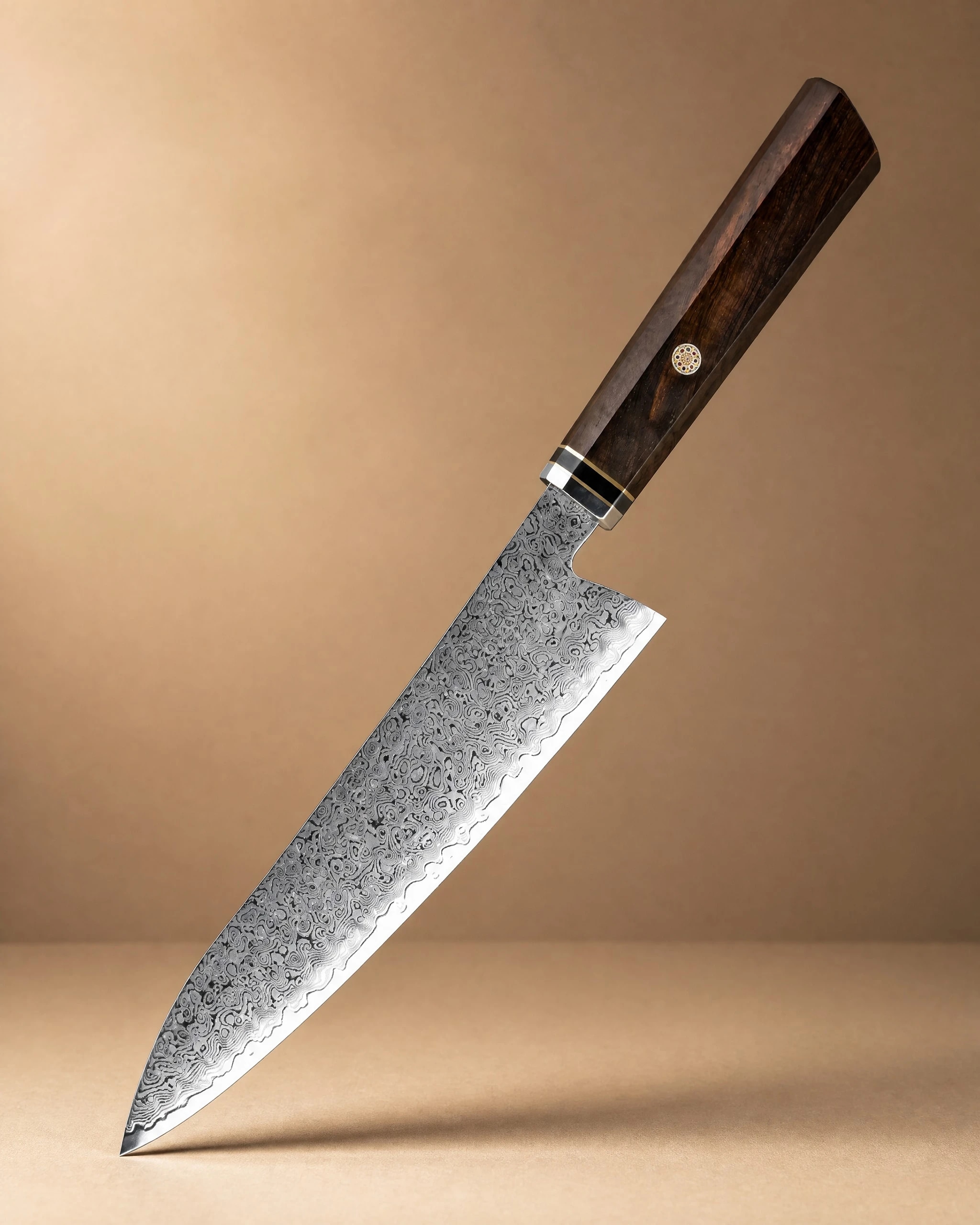 Sakawa 8.5" Damascus Steel Gyuto Knife 牛刀$74.99View product → The Sakawa runs a half inch longer than the standard at 8.5 inches. That extra length gives you more room for long slicing strokes and larger hands, and it is a natural fit for cabbage, squash, and big proteins. If your board is small or your kitchen is tight, the extra reach can feel like extra blade to manage.
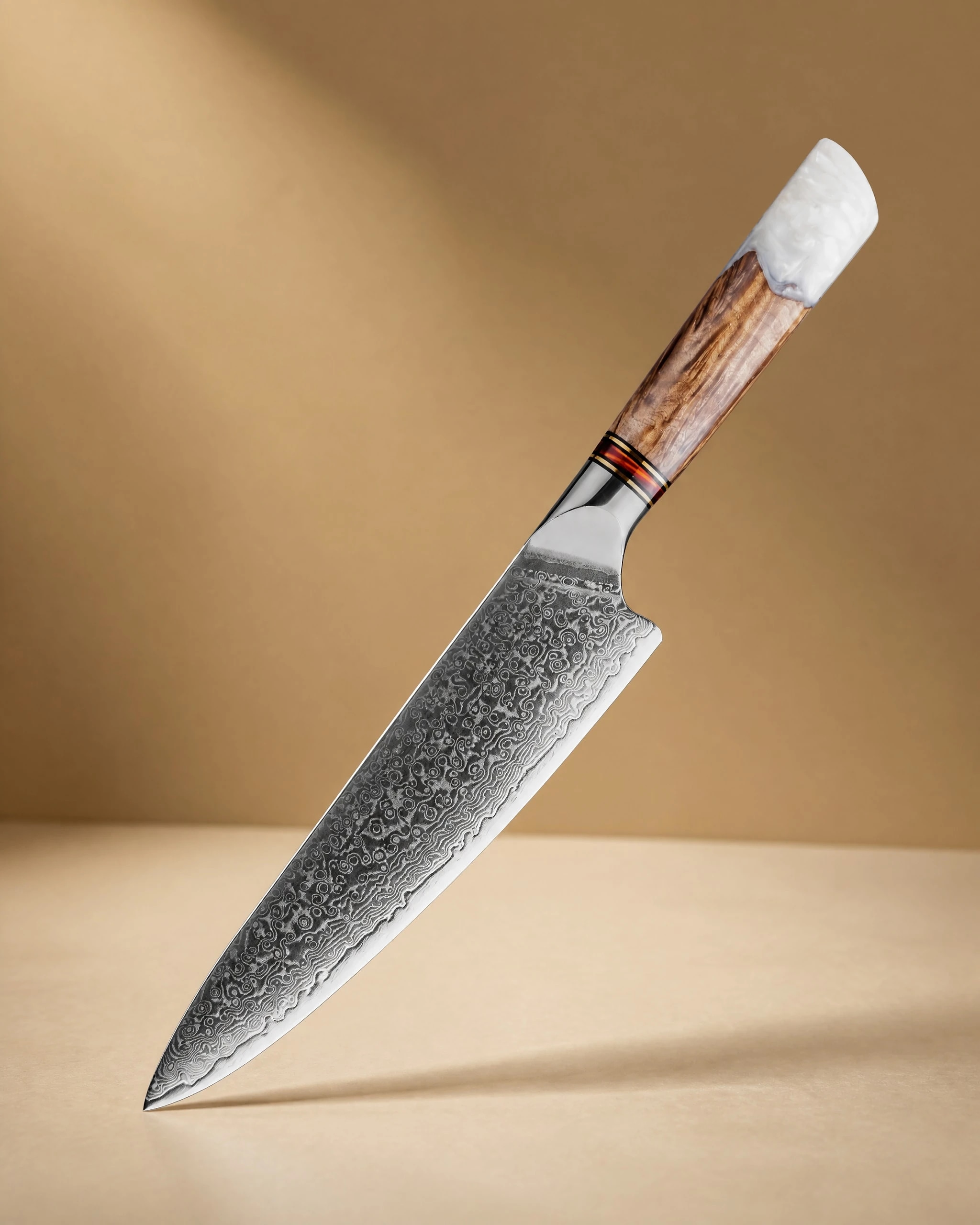 Shirakawa 白川 8" Damascus Steel Gyuto Knife 牛刀$74.99View product → The Shirakawa lands at the 8 inch mark most cooks settle on. It keeps the Damascus face and the everyday gyuto geometry, and it is the safer pick if you are replacing a first chef's knife and want a familiar length. For most home prep, this size disappears into the work.
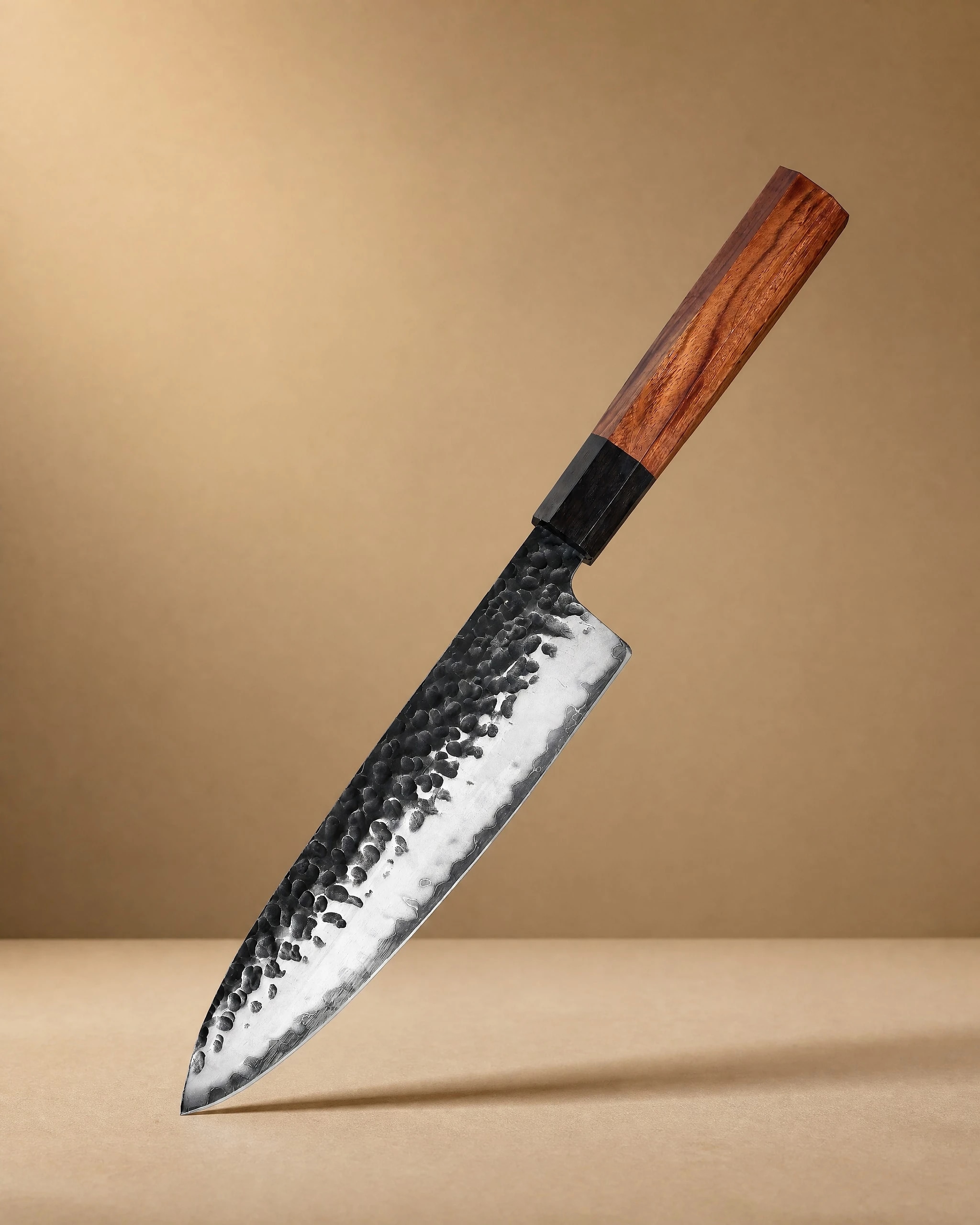 Tenjin 8" Stainless Steel Gyuto Knife 牛刀$59.99View product → The Tenjin steps away from Damascus entirely and uses stainless steel. That makes it the practical choice if you would rather not think about drying the blade immediately or watching a patina develop. It also suits cooks moving from a heavier Western knife.
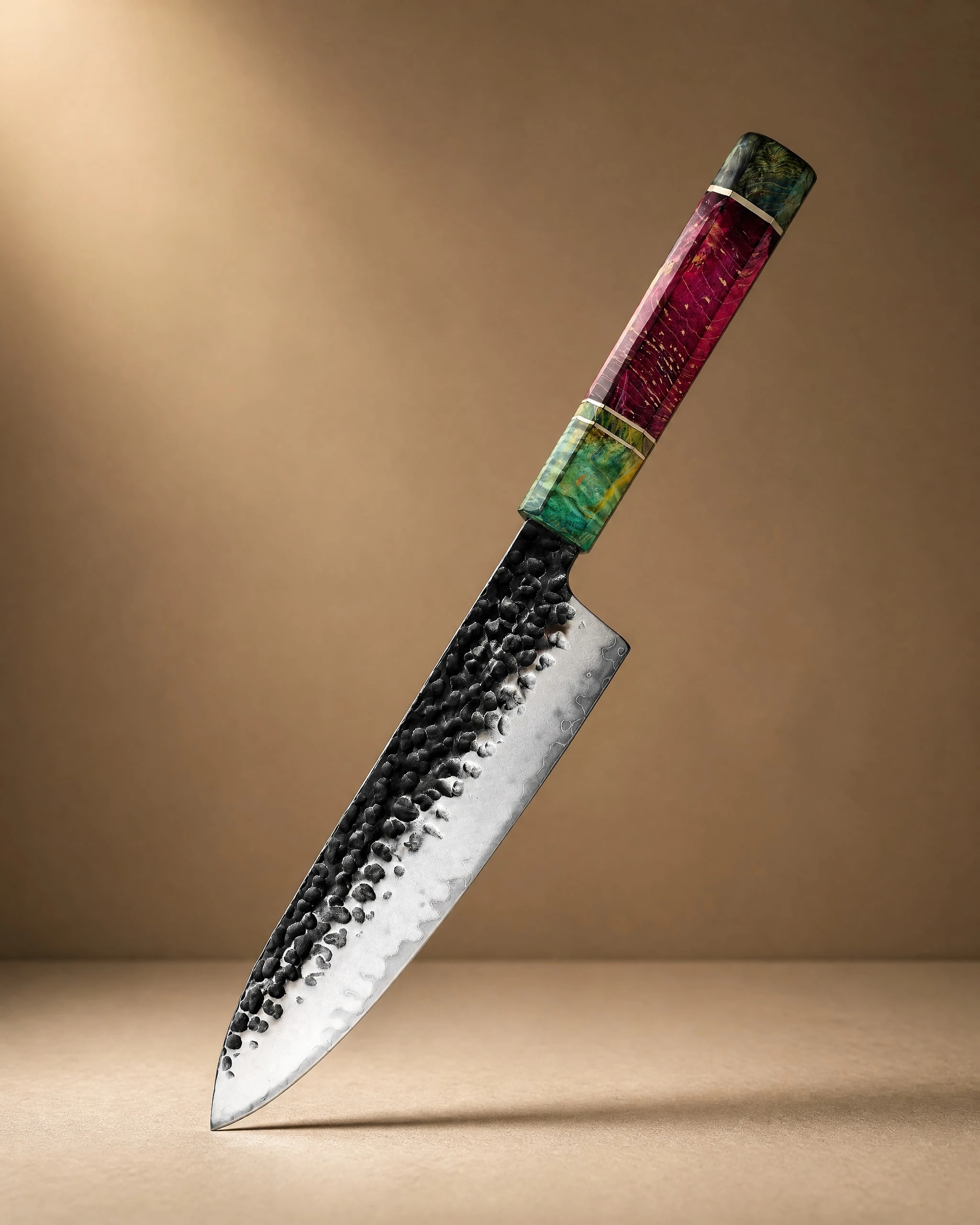 Natori 8" Gyuto Knife 牛刀$69.99View product → The Natori is a clean 8 inch gyuto with no pattern to maintain and a straight read on what you are buying. If the Damascus look is not what drew you in, this is where the decision gets simple.
Handle Style Changes How the Knife Feels More Than You Expect
Two families dominate. Western, or yo, handles are shaped and riveted, often with a full tang running the length of the handle. They feel familiar and put a little more weight behind the blade. Japanese, or wa, handles are lighter, usually a wooden or composite grip fitted to a partial tang, and they shift the balance point forward toward the blade. The knife feels quicker in hand and less tiring over a long session of prep.
Balance matters more than any single measurement. Pinch the blade between thumb and forefinger just ahead of the handle and see where the knife wants to rest. If it tips forward hard, your wrist will fight it all evening. Handles also vary in shape, from oval to octagonal to asymmetrical, and the differences are small on paper and obvious in the hand.
8 Inches or 8.5, and When to Go Longer
Eight inches, about 210 millimeters, is the default because it handles a whole onion, a chicken breast, and a bunch of parsley without feeling like a sword. An 8.5 inch blade, roughly 215 millimeters, adds a little reach and a little weight. It suits cooks with larger hands, people who work on big boards, and anyone who finds themselves sawing through wide vegetables. The cost is maneuverability in tight spaces and slightly more effort on small detail work.
If you already own a 210 millimeter gyuto and want a second knife, going longer is more useful than buying a near-duplicate. If this is your first, stay at 8 inches.
Keeping a Damascus Blade Looking Right
A Damascus finish is a surface, and surfaces change. The etched pattern will dull slightly with repeated washing and sharpening, and it can be refreshed, but the practical goal is to avoid the things that damage it.
Wash and dry by hand, immediately, every time. Dishwashers combine heat, moisture, and detergent, and they knock the edge against other items. Skip them. Keep the knife off the drying rack and out of the sink. Cut on wood or a soft synthetic board, never glass or stone. Do not use it on bones, frozen food, or hard seeds.
Sharpen on stones or a guided system rather than a pull-through sharpener, which removes too much steel and can chip a thin edge. Between sharpenings, a few passes on a strop or a fine rod keep the edge aligned. The full routine, including which stones to start with, is in our knife care guide.
A Short Buying Checklist
- Length: 8 inches for a first gyuto, 8.5 or longer for a second knife or larger hands.
- Core steel: stainless for low maintenance, carbon for a keener edge and more attention.
- Pattern: buy Damascus because you want the look and the craft, not because it cuts better.
- Balance: hold the knife in a pinch grip and check where it settles.
- Handle: wa handles feel lighter and forward balanced, yo handles feel familiar and heavier.
- Care: hand wash, dry immediately, wood or synthetic boards, stones for sharpening.
Where to Start
If you are still deciding between profiles, browse the full knife shop to see what else is available, or go straight to the gyuto category if the shape already makes sense for your cooking. Either way, pick the length and the core steel first, then let the finish decide the rest.
A Damascus gyuto is a working knife that happens to be beautiful. Buy it for the work it will do, take care of it, and the pattern is a bonus you get to look at every night while you cook.
Photography: Joseph Van via Unsplash.