
Best Japanese Knife Sets for the UK

Home cooks in the UK often end up with a drawer full of knives that only get used for basic tasks. A few slices into a tomato and the edge is already struggling. That is why a Japanese kitchen knife set deserves a closer look. Japanese blade design tends to be thinner, harder, and more focused than the average Western block, which means cleaner cuts and less crushing of delicate ingredients.
This guide is for UK buyers who want a practical Japanese cooking knives set without getting lost in marketing language. We cover the basics of steel, Damascus patterns, and how to match a set to the way you actually cook, and we keep the recommendations honest. If you want to browse first, visit the knife sets category.
Why a Japanese Kitchen Knife Set Works So Well
A set of Japanese knives is not about having more blades. It is about having the right edge and the right geometry for each task. The knives are often lighter than European-style knives, with a flatter blade profile that makes a clean, downward cut instead of a heavy rocking motion. For home cooks in the UK, that translates to less pressure on the wrist and faster prep work.
Another reason to consider a Japanese kitchen knife set is maintenance. Many Japanese knives are carbon steel, but the sets below use stainless steel. Stainless steel does not require the same level of attention in a damp climate, so it is easier to keep up with when you are just trying to get dinner on the table.
That does not mean every Japanese knife set is right for every cook. Some blades are fragile, some handles feel too small, and some knife blocks take up too much counter space. The key is to understand what you are buying before you compare.
What Makes a Quality Japanese Cooking Knives Set
When you search for the best Japanese kitchen knife set, you will see different price points and plenty of sharp-looking images. The quality is not in the logo or the color of the handle. It is in the steel, the grind, and the balance.
- Edge geometry. A thinner blade can slide through food with less effort, but it also needs a cutting board that will not dull it quickly.
- Steel choice. Stainless steel is the more forgiving option for everyday prep, especially when you live somewhere with humid weather.
- Balance and weight. The knife should feel neutral in your hand, with no blade-heavy or handle-heavy surprises.
- Practical knife selection. A set with eight knives is more useful than a display case filled with blades you will never touch.
If you are new to Japanese knives, the knife guide explains the main blade shapes and handle styles in plain English. That context helps when you are comparing a professional Japanese knife set with a smaller home set.
The Appeal of a Japanese Damascus Knife Set
A Japanese Damascus knife set is easy to recognize by the wavy pattern in the blade. That pattern comes from different layers of steel that are forged together and etched to show the structure. In many knives, the Damascus pattern is mostly cosmetic. The actual cutting performance comes from the blade geometry and the steel at the edge.
For UK cooks, the more important detail is stainless steel. A Damascus knife set Japanese makers create often uses stainless steel as the core, which means you get the dramatic look without the constant wiping and oiling that carbon steel demands. That makes a Damascus stainless steel set a sensible middle ground for someone who wants a beautiful knife but also wants to use it every day.
There is no reason to be afraid of a patterned blade. The pattern is part of the steel itself, not a coating that will wear off. With normal care, it continues to look good while doing the job it was made for.

Top Japanese Knife Set Options for Everyday Prep
The best Japanese kitchen knife set for you depends on your hand, your cutting style, and the amount of kitchen space you have. All three sets featured here are 8 piece sets designed for everyday prep, which means the focus is on utility rather than filling a fancy block with unused extras.
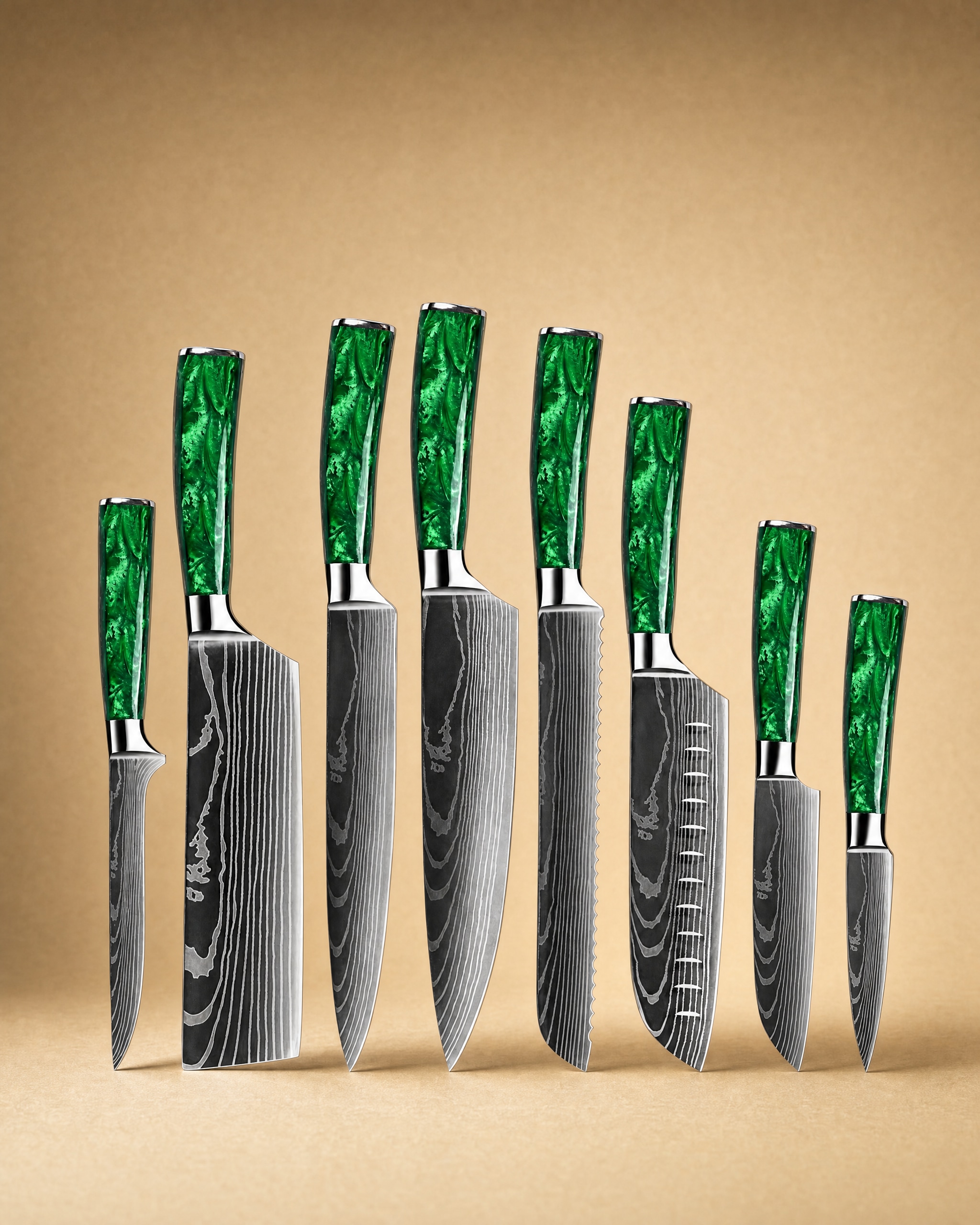 Kitakami 北上川 Damascus Pattern Stainless Steel Kitchen 8 Knife Set$189.99 · currently out of stockView product → is the set to start with if you want a dependable all-rounder. The Damascus pattern gives the blades a refined look, and the stainless steel keeps the upkeep simple. It is best for everyday prep because the included knives handle the tasks that come up most often, from slicing vegetables to trimming poultry and cutting fruit. If you only look at one option, this is the one to weigh first.
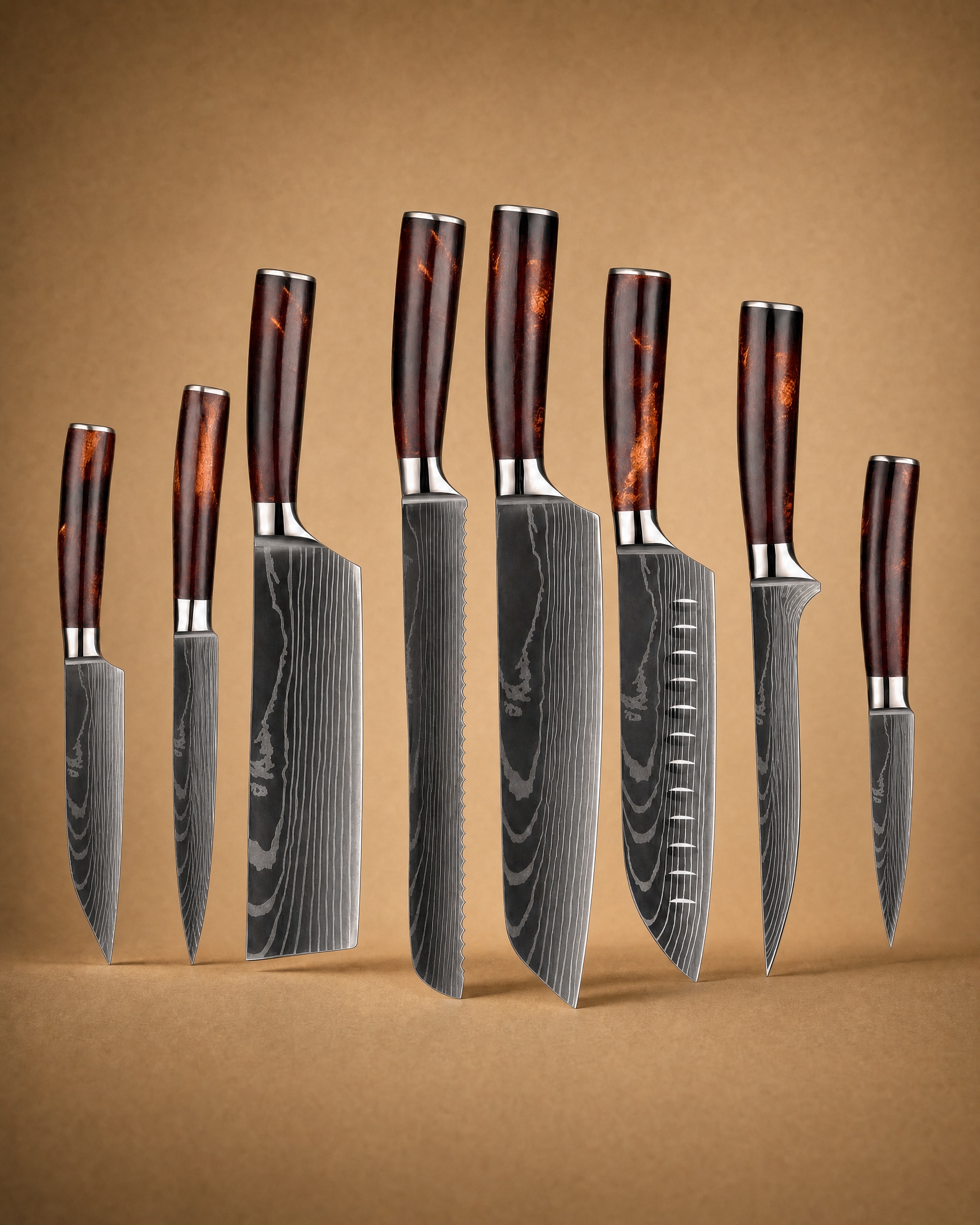 Asahi 朝日川 Damascus Pattern Stainless Steel Kitchen 8 Knife Set$189.99 · currently out of stockView product → is a strong alternative and worth comparing directly with the first set. The same everyday prep philosophy applies, but the handle and the balance may suit your grip better. When a knife set feels right in your hand, you use it more, and that makes the prep easier. Put both sets side by side, pick them up, and see which one feels natural.
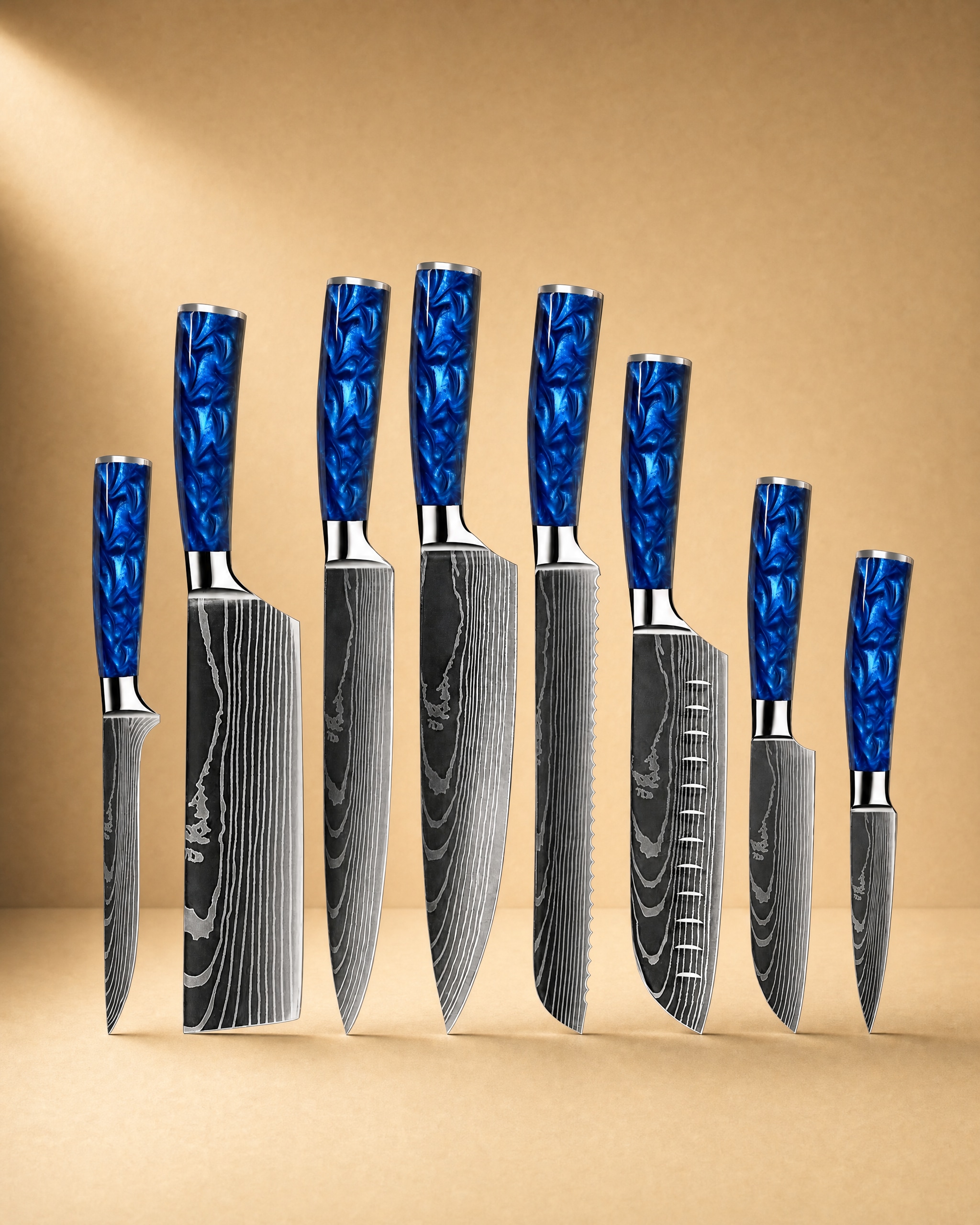 Shinano 信濃川 Damascus Pattern Stainless Steel Kitchen 8 Knife Set$184.99 · currently out of stockView product → completes the trio for anyone who wants a Japanese damascus knife set with a slightly different personality. It still fits the 8 piece everyday prep format, and the stainless steel blade is just as practical. If the first two options feel close, the final decision often comes down to the handle shape and the overall weight of the blades.
How to Compare the Sets Without Getting Lost
Start with storage and space. A Japanese knife block set can keep blades organized on the counter, but a magnetic strip or knife roll might be smarter if you cook in a small kitchen. The phrase Japanese knife set with block is popular for a reason, but the storage method should fit your kitchen, not look good in a photo.
Think about how you hold a knife. A professional Japanese knife set often has a lighter, more nimble feel than a German-style set. For some cooks that is an adjustment. If you are used to a heavy Western chef knife, a thinner Japanese knife can take a few days to feel natural. That is not a flaw. It is simply a different cutting motion.
Be careful with a Japanese knife set sale that offers many knives for a very low price. The number of blades is not a sign of quality. A well-made 8 piece set will outperform a cheap 20 piece set because the grind is what matters at the edge. Focus on the steel and the geometry instead of the count.
Caring for Japanese Knives in the UK
A Japanese steel knife set will last a long time if you treat it properly. The most important rule is to wash by hand and dry immediately. Dishwashers can damage stainless steel over time, and the heat and detergent are hard on any edge.
Use a wooden or plastic cutting board instead of glass, stone, or metal. These harder surfaces will roll the blade quickly and turn a sharp knife into a dull one. After washing, store the knives where the edges cannot knock against other metal. If a set includes a sheath or a blade guard, use it.
Sharpening is also part of the deal. Japanese knives can be sharpened on a whetstone, but a pull-through sharpener may not suit every edge. The knife care guide covers the basics of wiping, storing, and sharpening so your knives stay in good shape for years.
Humidity in the UK can work against you if you leave a knife wet. A damp blade, especially one with a Damascus pattern, can develop spots even if it is stainless. A quick wipe and dry after use takes ten seconds and removes most of the risk.
Where to Start
The right Japanese kitchen knife set is the one that fits your hand and your routine. For most UK home cooks, an 8 piece stainless steel set is a practical place to begin. You get the essential kitchen knives, you do not waste storage space on extras, and you can enjoy the sharp edge that Japanese knife making is known for.
To see what is available right now, start with the full product range or jump straight to the knife sets category. Compare the product cards, check the handle details, and choose the set that feels like it belongs in your kitchen. Then give yourself a few days of prep time to get used to the lighter, sharper cutting motion. Once you do, it is hard to go back to a dull drawer.
Photography: EMANUELE Ricciardi via Unsplash.


